
“`html
The “One-Touch Rule” That Makes Your Home Look Always Clean
We’ve all been there. You walk through the front door after a long day, kick off your shoes, drop your mail on the kitchen island, drape your coat over the back of a chair, and sink into the sofa. In that moment, it feels like you’re resting. But in reality, you’ve just assigned yourself a list of chores for later. Those shoes, that mail, and that coat are now “clutter items” that will haunt your visual field until you finally decide to deal with them.
What if I told you that the secret to a perpetually clean home isn’t a grueling four-hour cleaning session every Saturday? What if the secret isn’t a high-end robot vacuum or a professional maid service? The secret is a simple, psychological shift in how you interact with the objects in your environment. It’s called the One-Touch Rule.
In this guide, I’m going to break down exactly what this rule is, why it works on a neurological level, and how you can implement it in every room of your house to ensure you never have to “spend the day cleaning” ever again.
What is the One-Touch Rule?
The One-Touch Rule is exactly what it sounds like: Once you touch an item, you do not put it down until it is in its final destination.
Think about the life cycle of a coffee mug. In a typical home, you finish your coffee and set the mug on the coffee table. Later, you move it to the kitchen counter. Later still, you put it in the sink. Finally, you put it in the dishwasher. You have touched that mug four times. Under the One-Touch Rule, you finish your coffee, walk to the kitchen, and place it directly into the dishwasher. One touch. Task complete.
This rule is about eliminating the “middle ground.” It’s about refusing to create “doom piles”—those stacks of things that you intend to deal with later but never do. By committing to one touch, you prevent the accumulation of clutter before it even starts.
The Psychology of the “In-Between”
Why do we struggle so much with keeping things tidy? It’s rarely about laziness. It’s about decision fatigue. Every time you look at a piece of mail on your counter, your brain has to process it: Is that a bill? Do I need to keep it? Where does it go? If you don’t decide immediately, you defer that mental energy to later. Do this with twenty items, and your brain is subconsciously exhausted just looking at your living room.
The One-Touch Rule removes the need for repeated decision-making. You make the decision once, you act on it, and the item is gone from your mental “to-do” list. This creates a sense of “closed loops” in your brain, which significantly reduces stress and anxiety levels at home.
Implementing the Rule: A Room-by-Room Guide
Applying this rule takes practice. You are essentially re-wiring years of habits. Let’s look at how this looks in action across different areas of your home.
1. The Entryway: The First Line of Defense
The entryway is where most clutter begins. It is the transition zone between the outside world and your sanctuary. If the One-Touch Rule fails here, it will fail everywhere else.
- Mail: Don’t drop it on the table. Stand over the recycling bin. Junk mail goes in immediately. Bills go into your filing system or designated “to-pay” folder. Personal letters are opened and stored. Touch it once.
- Coats and Shoes: Instead of dropping them on the bench, hang the coat on the hook and place the shoes in the rack. It takes exactly four seconds longer, but saves you a ten-minute “tidy up” later.
- Keys and Bags: Give them a home. If you touch your keys, they go on the hook. Period.
2. The Kitchen: Preventing the Pile-Up
The kitchen is the heart of the home, but also the headquarters of “I’ll do it later.”
When you finish a meal, the One-Touch Rule dictates that the plate doesn’t go in the sink—it goes in the dishwasher. If you’re cooking, the spices don’t stay on the counter until you’re done; you use the oregano, and then you put it back in the cabinet immediately. By the time the meal is served, the kitchen is already 90% clean because you “one-touched” your way through the preparation.
3. The Living Room: Maintaining the Sanctuary
The living room often becomes a graveyard for items from other rooms. To maintain this space, you must be vigilant about the objects you bring into it.
- Blankets and Pillows: When you get up from the sofa, fluff the pillow and fold the throw. Don’t leave it for “before bed.”
- Remote Controls: Don’t leave them tucked in the cushions. Place them in their designated tray or basket as soon as the TV goes off.
- Hobby Items: If you’re knitting or reading, when you’re done for the session, put the supplies back in their bin or the book back on the shelf.
4. The Bedroom: Ending the “Floordrobe”
We’ve all had that one chair—the one that exists solely to hold clothes that are “not quite dirty, but not quite clean.” This is the ultimate violation of the One-Touch Rule.
When you take an item of clothing off, you have two choices: it goes into the hamper, or it gets hung back up. There is no third option. By refusing to let clothes sit on surfaces, your bedroom remains a calm, restful environment rather than a chaotic storage unit.
Why “Later” is a Liar
We tell ourselves that “later” we will have more energy. We tell ourselves that it’s more efficient to clean everything at once. This is a fallacy. Cleaning a week’s worth of accumulated clutter takes hours and is emotionally draining. Spending five seconds putting a stapler back in a drawer is effortless.
The One-Touch Rule is built on the principle of Micro-Habits. Small actions, repeated consistently, lead to massive results. When you stop lying to yourself about “later,” you realize that “now” is actually the easiest time to do anything.
The Hidden Barrier: Inefficient Storage
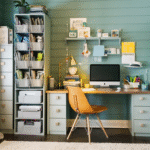
If you find the One-Touch Rule impossible to follow, the problem might not be your discipline—it might be your storage. If it takes three steps and moving two boxes to put away your vacuum cleaner, you aren’t going to do it. You’ll leave it in the hallway.
To make the One-Touch Rule work, your storage must be accessible.
- Everything must have a “home.” If an item doesn’t have a designated spot, you can’t put it away with one touch.
- The home must be easy to reach. Frequency of use should dictate proximity. The things you use every day should be the easiest to put away.
- Eliminate lids where possible. Baskets without lids are the best friend of the One-Touch Rule because they remove one extra step from the process.
Dealing with Other People (The Family Dynamic)
It’s one thing for you to adopt the One-Touch Rule; it’s another to get a partner or children on board. The key here is not to lecture, but to demonstrate and facilitate.
Start by explaining the why. Explain that this isn’t about being “neat freaks”—it’s about freeing up your weekends so you can spend time together rather than cleaning. Then, make it easy for them. If your kids always drop their backpacks in the hall, put hooks at their height right where they drop them. You are modifying the environment to fit the rule.
The “Touch It Once” Laundry System
Laundry is the final boss of home organization. Most people touch laundry six or seven times: hamper, washing machine, dryer, “the basket,” the bed, and finally the drawer. To apply the One-Touch Rule here, you have to compress the back end of the process.
When the dryer dings, don’t move the clothes to a basket to “fold later.” Fold them directly out of the dryer and put them away immediately. If you don’t have time to put them away, don’t start the dryer. By ensuring the cycle ends with the clothes in the drawer, you eliminate the “laundry mountain” that plagues so many households.
The Mental Health Benefits of a One-Touch Home
There is a documented link between physical clutter and cortisol levels (the stress hormone). Our brains are wired to find order; when we are surrounded by unfinished tasks (which is what clutter represents), our nervous system stays in a state of low-level “alert.”
When you adopt the One-Touch Rule, you aren’t just cleaning your house; you are quietening your mind. You will find that you sleep better, you’re more productive when you work from home, and you feel a greater sense of control over your life. The home becomes a place of restoration rather than a place of work.
Common Pitfalls and How to Avoid Them
The “It Only Takes a Second” Trap: You might think, “Oh, I’ll just put this here for a second while I grab my coffee.” This is the crack in the dam. Once you break the rule once, it becomes easier to break it again. Stay disciplined.
The Perfectionism Paralysis: Don’t worry if you don’t have the “perfect” storage bin yet. Use what you have. The rule is about the action of putting things away, not the aesthetic of the containers.
Overwhelming Yourself: If your house is currently messy, don’t try to “one-touch” the existing mess. Spend one final weekend doing a deep purge and organization. The One-Touch Rule is a maintenance strategy, not a deep-cleaning strategy. Start with a clean slate.
The 30-Second Rule Corollary
To support the One-Touch Rule, I always recommend the 30-Second Rule: If a task takes less than 30 seconds, do it now. Wiping a spill, hanging a towel, closing a drawer—these are tiny actions that, when ignored, compound into a messy house. When combined with One-Touch, these two habits become a powerhouse for home management.
Conclusion: Reclaiming Your Time
We often think that people with clean homes spend all their time cleaning. The irony is that the people with the cleanest homes usually spend the least amount of time cleaning. They simply refuse to let the cleaning tasks accumulate. They have mastered the art of the One-Touch Rule.
By making the decision to put things where they belong the first time you handle them, you are gifting yourself hours of free time every week. You are removing the guilt of the “doom pile” and the “floordrobe.” You are creating a home that is always ready for a surprise guest, and more importantly, always ready for you to relax in.
Start today. The next time you go to set something down on a surface where it doesn’t belong, stop. Take the extra five steps. Put it in its home. Experience the satisfaction of a task truly completed. Your future self will thank you.
Key Takeaways to Remember:
- Touch it once: From hand to home, no pit stops.
- Eliminate “Later”: Later is where clutter lives.
- Optimize Storage: Make it easier to put things away than to leave them out.
- Close the Loops: Every item put away is a mental task cleared.
- Consistency over Intensity: Small daily habits beat massive weekly clean-ups.
“`